
Exhibiting Locative Media: (CRUMB discussion postings)
In cultural circles, the ‘locative media’ media meme seems this year to have reached its zenith. After a summer camp in Latvia focused on the phenomenon last year, and conferences far and wide featured snippets in their programmes, this year the ISEA2004 and Futuresonic festivals have pushed wireless worlds centre stage. Faced with as much uncritical gadgetphilia as abject info-paranoia – courtesy both, it sometimes seems, of these technologies’ military roots – how are curators to sensitively engage with the field? During April 2004, the email list of CRUMB, the Curatorial Resource for Upstart Media Bliss discussed just this. Beryl Graham compiled the results
This article edits selected postings from the New Media Curating discussion list <http://www.jiscmail.ac.uk/lists/new-media-curating.html>. They have been spellchecked, edited, and arranged in order to follow a particular thread of debate. Omitted text is marked with […]. The full postings can be seen and searched via the web site. A longer set of edited posts (‘locative.rtf’ 9500 words) is also available from the site).
The list is the public forum for the web site The Curatorial Resource for Upstart Media Bliss http://www.newmedia.sunderland.ac.uk/crumb.
Beryl Graham 14 May 2004
The CRUMB discussion list aims to share practical experience concerning curating/exhibiting new media art. The discussion is open to all, and every other month the co-editors introduce a ‘Theme of the Month’ with invited respondents. Sometimes this is done in collaboration with an event (in this case, Futuresonic), and always depends on the generosity of guests and list members.
Despite being university-based, CRUMB tries to ensure that academics don’t take over the debate (theorists seem to have more time than curators and artists, or maybe they just type faster). This practical Locative theme aimed to complement the substantial current theoretical material on locative media, (including Saul Albert’s excellent work in Mute).
For me, three key factors run across the named threads of the debate, all of which are informed in particular by the presence of curators and artists:
1. Which history? The posts include many references to both artistic and textual works, which are often some of the most valuable things about online debate, and put the artwork in diverse contexts and histories. The posts include references to Duchamp, skateboarding, Muybridge, feminist art, Situationists, the Whitehouse web site, Virilio, geocaching, Walter Benjamin, the cautionary tale of Holography, and how to make wireless antennas from noodle scoops. The ‘sonic’ aspect obviously also represents an important history, and one which was discussed in another list theme in March 2002. Now that new media is mature enough to admit to having parents, it seems that there are many relevant histories which struggle to make sense of each other (technology, art, culture, politics), and discussion lists are often the place where this happens.
2. Curating what? Drew Hemment pithily asked, with reference to Muybridge’s early photographs: ‘Is curating mobile media like catching in still photography the moment the horse's feet leave the air? Or should the curator be on the horse?’------Among the varied responses is Patrick Lichty’s admirably practical acknowledgement that curators are often dealing with difficult issues of timing, that the ‘active cycle’ of an exhibition is only part of the fluid continuum of the artwork, and that formalist concerns may have to be sacrificed for concerns of speed. Curators, when open about their process, are usefully willing to admit that the role is more rodeo than dressage, with a certain amount of face-down in the dust, and that occasionally the role might be plodding along way behind with a bucket and an unhealthy interest in preservation. As Ilze Black says, ‘… not many are on horse, but does that makes the horse race less interesting?’ One of the basic pragmatic tasks of curating is to show something of the horse to the crowd, and sometimes, as with Muybridge, this involves showing something ‘which was not viewable.’ (Ivan Pope). In the case of this discussion, showing the unviewable was most usefully illustrated by references to specific artworks or shows, such as ParkbenchTV, webmapper.net, murmurtoronto.ca, or nycbloggers.com.
3. Technology and power? Artists and curators have been struggling for some time with the dubious parentage of technologies – from the Internet (military and porn), VR (military), video (surveillance and porn) and yes, locative media (military and surveillance). Those who struggle to be rigorous in making good art with expensive media have also had to deal with the dominant business tropes of ‘research and development’. As a photography student in the 1980s, I tussled with the ambivalence of the medium’s voyeurism and representational politics, as well as with the problem identified by Naomi Spellman in her CRUMB post, ‘…that criticality for now at least all too easily becomes surface ornament, an easy way to equate a work with intelligence, hipness, or awareness.’ No doubt the struggle for The Devil’s Best Tunes will continue to rage.
These excerpts are of course just cupped hands in the stream of the debate, a few sips from the choppy waters of upstart media (at least 17,000 words 1st-April to 14th May). Some interesting threads on education and locative gaming have here regretfully been omitted, but I hope this might at least form a digestible introduction to the debate.
______________________________
 > Eadweard Muybridge, Horse Galloping, 1878
Date: Thu, 1 Apr 2004 21:32:48 +0000From: Beryl Graham <beryl.graham AT SUNDERLAND.AC.UK>Subject: Exhibiting Locative Media, April Theme of the Month
Dear List,
April Theme of the Month: Exhibiting Locative Media
This year, the futuresonic festival (and conference) in Manchester, UK, <http://www.futuresonic.com> features much 'locative' or mobile media. This month, the guests have been selected in association with Drew Hemment of futuresonic.
What are the practical challenges of exhibiting media which are international yet local, mobile yet grounded?
Invited Respondents:
Ilze Black (UK) Curator, Goldsmiths College<http://richair.waag.org> (later in the month)Jonah Brucker-Cohen (US) Artist <http://www.coin-operated.com>Ceri Hand (UK) Senior Curator, FACT <http://www.fact.co.uk>Katherine Moriwaki (US) Artist <http://www.kakirine.com>Michael Pinsky (UK) Artist <http://www.michaelpinsky.com>Patrick Lichty (US) Curator <http://www.intelligentagent.com>Annabel Longbourne (UK) firstsite @ the minories art gallery<http://www.firstsite.uk.net>Fee Plumley (UK) the-phone-book Limited <http://www.the-phone-book.ltd.uk>Glen Redpath (US/Can) ArtistLisa Roberts Blink (UK) <http://www.blinkmedia.org>Andrew Wilson citypoems (UK) <http://www.fisharepeopletoo.co.uk>Jen Southern (UK) Artist <http://www.theportable.tv>Naomi Spellman, Jeff Knowlton and Jeremy Hight (USA) InterUrban<http://www.34n118w.net>Steve Symons (UK) Muio <http://www.muio.org>Marc Tuters (CA) Locative Media Lab <http://www.locative.net/drupal/>
______________________________
Date: Tue, 13 Apr 2004 20:11:30 +0300From: marc <mt AT X-I.NET>Subject: locative forbearers
[…] My interest in ‘locative media’ has been less about making location-based wireless art, I guess, than theorizing the emergence of this ‘geospatial web’ (i.e. ‘won't it be great when we can all access messages left in space and get a sense of the shared digital/spatial history of a place?’)
The problem with that angle on locative media is basically this: until enough people get these ‘locative’ devices – assuming that even if that ever happens, and assuming that we even want that to happen – there will never be an accumulation of enough ‘geo-annotations’ to make accessing the ‘geospatial web’ a compelling experience. […]
I think that a project that did so would be doing more than simply art (not that art is simple or that it isn't enough on its own), but such an initiative would really also be doing foundational work, at least at a tech-dev level, for establishing a kind of collaborative commons for locative knowledge, something that I think would come closer to a public space for the 21st C than all the National Lottery funded art galleries and other weird public spaces that city councils seem to think is the best way to spend public money. […]
Marc Tuters
______________________________
Date: Tue, 13 Apr 2004 22:39:45 -0500From: patrick lichty <voyd AT VOYD.COM>Subject: Curating Locative Media
>>> Is curating mobile media like catching in still photography the>>> moment the horse's feet leave the air?
Well, that's an interesting question, isn't it? Assuming that there's a horse in motion, and that it can somehow be captured?
In contrast with my (re)distributions show and the upcoming mo/Pho show (mobile Photography), the approaches are quite different.
As a framing gesture to talking about curating locative media, I'll admit that it is challenging and represents something that challenges site (even beyond the screen, which can be as non-gallery as it gets) as well as objectification, materialism, and so on. So what I have found is that I had to embrace a certain amount of fluidity in my signification between the representation of the work and the potential of experiencing the work itself, from a developmental, experiential, etc perspective. With locative media, as well as many other new media, I have personally decided to take the chance of formalist concerns possibly slipping, reconfiguring, or totally evaporating. If your media and platform are in motion, why not your signifiers?
In fact, for the redist show, (http://www.voyd.com/ia) my active curation period spanned over seven months. This was due to the fact that so many artists working with PDAs and mobiles were in the development stages, so I allowed anything from people coming on 4-5 months after the beginning/opening of the show and the 'closing' of what I called the 'active cycle' of the show.
What I likened it to was [a] metaphor that I was taught that allowed me to grasp the idea of the event, and that's the idea of throwing half-congealed gelatine against the wall and documenting its trace. Of course, it's in motion, and if you try to nail it in place, it's obvious that it's a problematic process. However, when you're done, you will have a trace (trail of gelatine) and a series of nails (records of events) that construct an epistemic arc, and perhaps this is my model, more or less.
I think that for platforms and media that are constantly in motion, it's next to impossible to 'capture' them, to use the original Muybridge example. I'm not sure how to extend the metaphor to the next step; […] the horse will have morphed into a bluebird dancing a jig? However, you have a series of context-specific images of the thing as a horse running, and I think that's of use.
My metaphors are quite incomplete, but it's safe to say that although the subject is always in motion, the record is still of use, whether it constitutes a discursive site, trace, space or continuum.
Patrick Lichty
______________________________
From: Marc Tuters <nodus AT sympatico.ca>Date: 13 April 2004 20:51:34 BSTSubject: Re: April Thought For The Day: Exhibiting Locative Media
drew hemment wrote:
Is curating mobile media like catching in still photography the moment the horse's feet leave the air?
if by that you mean that the content is ephemeral and the media often maddeningly technical, i'd say yah sure... […]
M.
______________________________
From: ilze black <black AT open.x-i.net>Date: 13 April 2004 21:30:33 BSTSubject: Re: April Thought For The Day: Exhibiting Locative Media
…i would say both applynot many are on horse, but does that makes the horse race less interesting?
besides there will also be those who will turn back the negative tape to see the head, hopefully, the question remains will that be the horse or image of horse that then will matter
/ib
______________________________
Date: Wed, 14 Apr 2004 11:22:53 +0100From: Ivan Pope <ivan AT IVANPOPE.COM>Subject: Re: April Thought For The Day: Exhibiting Locative Media
[…] Following on from the initial post on this subject: Muybridge set out to find out whether all the horses feet left the ground at the same time when it was galloping. This had been pondered for a long time and it seems amazing that it is not possible to work this out just by looking. Thus, photography was able to 'see' something that took place in front of a viewer but which was not viewable. […]
Cheers,Ivan
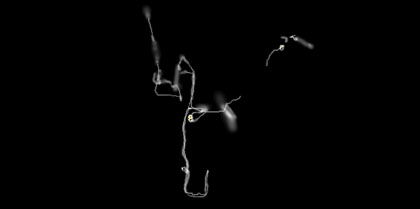 > Karosta Real Time map - screenshoot from KeyWorx (Mac based software by Waag Society): Military traceroute
______________________________
Date: Wed, 14 Apr 2004 10:08:13 +0200From: Andreas Broeckmann <abroeck AT TRANSMEDIALE.DE>Subject: Re: locative? tracked!
folks,
i don't want to spoil the party, but i have always understood the term 'locative' as pointing in both directions, the potential for enriching the experience of shared physical spaces (as described by Marc in his mail), but also fostering the the possibility to 'locate', i.e. track down anyone wearing such a device. this does turn the 'locative media' movement into something of an avantgarde of the 'society of control'. i believe that people are aware of the ambivalence, Drew has written about this, but i am wondering at which level this critical aspect is brought into an arts project. (as the marginalised 'yes, but'?)
consider the story below. in short, the runners of the london marathon will be carrying chips that will trigger SMS/text messages sent to their friends and relatives to report their progress in the race. any guesses for applications of this technology outside of the sports domain?!
this is not to say that artistic work in this field is impossible. I believe that, for instance the Milk project by Polak/Auzina might be a clever way of approaching the issues by simulating the tracking of trade routes. http://locative.x-i.net/piens/info.html
so much for the moment.
greetings from sunny berlin,-a
-----
http://www.vnunet.com/News/1153975 IT sets the pace at London marathonBy Emma Nash [31-03-2004]Runners' times and positions will be logged by electronic tags […]
______________________________
Date: Wed, 14 Apr 2004 07:58:01 -0500From: patrick lichty <voyd AT VOYD.COM>Subject: Re: locative? tracked!
Of course it means that there are agendas of control! I think that in a slightly different vein, Alex Galloway's new Protocol book gets into the idea of networked culture as systems of control, and track-able devices are an extension of that agenda.
With Rueb's Choreography of Everyday Life, she's taken this technology as a beautiful metaphor for drawing and dance of everyday life through making art from tracking technology. However it also makes one wonder if by picking up these devices, are we then in a form of 'house arrest' (what we call it in the States) where our every move can be watched at any time.
Are we talking about 1984? Aspects, perhaps. My question is to consider the nature of the form and function of the technology as in the classic Thamus/Thoth fable that Postman opens up Technopoly with. Is there a truly creative function for a gun? I think [Shirin] Neshat has proven that there is, only if you never fire it.
The functions of tracking technologies are disturbing to me, and I believe that it is surely in need of critical thought that has not come to the fore as of yet.
Patrick Lichty
______________________________
From: marc <mt AT x-i.net>Date: 14 April 2004 14:12:46 BST
Andreas Broeckmann wrote: ‘turn the “locative media” movement into something of an avantgarde of the “society of control”. i believe that people are aware of the ambivalence,’
This seems a little obvious to me really, I've always felt that in a society that emphasizes individualism, you can pretty much assume this will be the first thing in people's minds when you talk of a technology that involves location.
It's always been my attitude that you start with the assumption that mobile technology not only will track you, but is tracking you, and work backwards from a frank acceptance of the _existing_ society of control to develop useful hacks.
Andreas Broeckmann wrote: ‘Drew has written about this, but i am wondering at which level this critical aspect is brought into an arts project. (as the marginalised “yes, but”?)’
I think that an interesting critical-theoretical discussion of the aesthetics of this new medium would explore how it really begs to be framed through a new metaphor, that of the city and the vehicle rather than the screen...
In a text Jordan Crandall posted to Nettime in '97 <www.nettime.org/msg00027.html> he argued that we need a new metaphor to replace that of the cinematic theater – ‘a metaphor that begins to de-emphasize the visual field and instead emphasizes procedures of mobilization... The visual field is either disappearing or becoming something of a decoy, depending how you look at it. It is disappearing by imploding (miniaturizing) on the way toward direct INSERTION INTO THE BODY; or it is disappearing by expanding outward to take over the whole of reality itself – which is the condition of immersion. […]’
My point, I guess, is that while surveillance is in some crucial way at the core of this new medium, we should perhaps look to develop a more sophisticated critique than just dragging out Foucault or even Deleuze, _yet again_
The art that uses this technology has become a lot more sophisticated over these past couple years, so should the theory.
M
______________________________
Date: Thu, 15 Apr 2004 20:46:52 +0100From: Andrew Wilson <andrew AT BLINKMEDIA.ORG>Subject: Re: locative? tracked!
Hello. My name's Andrew Wilson and I'm one of this month’s invited contributors. I started in this direction – ‘locative media’? – in 2000 with a WAP site project called The Bus Stop Poems which was meant to be ‘poems on the underground from anywhere in the world’ and kept going.
marc tuters wrote:
‘My point, I guess, is that while surveillance is in some crucial way at the core of this new medium, we should perhaps look to develop a more sophisticated critique than just dragging out Foucault
For practical reasons I think I agree with that, just because there must be more fun and enlightening things to invent with locative media (if that's what it's called and whatever it is. Is there a definition of that phrase anywhere?) than ‘watch out, they're behind you!’
Andrew
______________________________
Date: Fri, 16 Apr 2004 00:52:16 +0300From: marc <mt AT X-I.NET>Subject: Re: locative? tracked!
Andrew Wilson wrote:
there must be more fun and enlightening things to invent with locative media (if that's what it's called and whatever it is. Is there a definition of that phrase anywhere?) than ‘watch out, they're behind you!’
I like Ed Mac Gillavry's <www.webmapper.net> definition: ‘an initiative to collectively create models of real-world locations online, that people can then access and use to virtually annotate locations in space. The value of the annotations is determined by physical and social proximity (expressed in distance and ‘degrees of separation’). Thus, the information is not only filtered based on proximity, but also ranked according to the trust one person has in another person through social networks.’
but that may be a bit a bit of a functional definition... too much web cartography (i guess in that sense responding with yasir's call) and not enough art.
According to wikipedia: ‘The locative case corresponds vaguely to the preposition "in", "at", or "by" of English and indicates a final location of action or a time of the action.’ <en.wikipedia.org/wiki/Locative_case>
But regarding ‘more fun and enlightening things to invent with locative media... than "watch out, they're behind you!"’... i don't mean to suggest that vigilance re: surveillance shouldn't be a foremost concern in locative work, but rather... I'd propose that _it's already there, at the core of what's motivated much of the work _ so much so, in fact, that it almost goes without saying... (not sure if anyone's with me here...)
If we follow Ed's definition from above... building a ‘accessible’ maps where location is, for example, measured by degrees of trust... that's a perilous path no doubt (Friendster ---> Total Information Awareness) but it's also an activist project towards constructing what i reckon (as I suggested in my first post too) amounts to a new public realm, accessed by the most ‘accessible’ communications technology in history, the mobile phone...
Of the people I've met who're making mapping hacks for mobile devices, they're doing so because they're feel like they want to, or _need to_ do something.
The artists, hackers, activists, whatever[ists]... that I am thinking of (such a large proportion of whom are from the UK), have a profound concern & commitment to public life...
Is it any coincidence that in the UK (where CCTV is most prevalent) technological SURVEILLANCE is just a fact of everyday life...
It's not some theory about ‘normative biopower’ (although that applies in spades too)... IT JUST _IS_!
M
______________________________
Date: Fri, 16 Apr 2004 10:03:07 -0400From: Christiane Paul <Christiane_Paul AT WHITNEY.ORG>Subject: Re: locative? tracked!
The 'locative' research that Intel is doing is also relevant to thisdiscussion (my apologies if this URL was already posted to the list):
Urban Atmosphereshttp://www.urban-atmospheres.net/ A research agenda specifically focused on exploring the facets and issues of computing in public urban spaces.
Jabberwockyhttp://www.urban-atmospheres.net/Jabberwocky/ A mobile phone application for visualizing and interacting with our urban landscape of familiar strangers. (initial trials are underway and a new version of the software will be release next month).
______________________________
Date: Sun, 25 Apr 2004 19:34:18 +0100From: Drew Hemment <drew AT FUTURESONIC.COM>Subject: Re: locative
>One work sits in a phone, another in a frame - but that>doesn't make it necessarily different....snip...>a free network is a political response...snip...>As a structure>it seems no different to a picture frame
A picture frame designates the status of that which it encloses as an art object, at the same time as it separates the art object from the world. A further act of distancing occurs by virtue of the critical distance of the perceiving subject and the physical distance from the perceiving body within the gallery context.
This might be opposed to what Walter Benjamin identified as a 'tactile' mode of perception, one characterised by distraction rather than concentration: 'Tactile appropriation is accomplished not so much by attention as by habit.' Benjamin relates this 'tactility' to the way in which architecture touches and directs the lives of those who move around and within it, not as a distanced object, operating on a more subconscious level, its affect all the more powerful for getting under the skin.
For a long time I have been interested in how Benjamin's thinking on cinema relates to the musical event, and it again comes to mind in relation to mobile and locative media. […]
Drew
______________________________
Date: Mon, 26 Apr 2004 11:10:34 -0700From: Naomi Spellman <spellman AT 34N118W.NET>Subject: Re: locative
I have been thinking of similar things lately. it seems that benjamin's concept of the aura, which was obliterated by cinema and tv as well, is reconnected within locative media, at least in the context of experimental projects and research. But it seems like there are two trends: one reintroduces our environment, immediate surrounding, and nearby citizens to us through mobile media, and one potentially alienates us further, in the sense that more and more we can function without need for direct human and tactile interaction. but i agree, this newfound complexity is the interesting part, as it is the unpredictable part and the part hard to compare to past mass media development, whether tv, print, etc.
>>One work sits in a phone, another in a frame - but that>>doesn't make it necessarily different.> ...snip...>>a free network is a political response> ...snip...>>As a structure>>it seems no different to a picture frame>> A picture frame designates the status of that which it encloses as an art> object, at the same time as it separates the art object from the world. A[…]
______________________________
Date: Tue, 27 Apr 2004 00:09:38 +0100From: Drew Hemment <drew AT FUTURESONIC.COM>Subject: 1984
Don’t worry, this post isn’t about Big Brother.
Reading Naomi's post I was thrown back to a misspent youth reading too much (no, really!) and I remembered what used to be a favourite text of mine many years ago – The Walkman Effect by Shuhei Hosokawa (1984).
It is quite famous, so I am sure that people on this list will be familiar with it, but does anyone know if this has been revisited in the light of the current buzz around mobile media.
If not watch this space ;)
(It was well over ten years ago that I last read it, so it might be a dead alley, I might even hate it now, but if you want the full reference it is Shuhei Hosokawa, ‘The Walkman Effect’, Popular Music Vol.4: Performers & Audiences, ed. R. Middleton & D. Horn, Cambridge University Press, 1984,pp.165-180)
Drew
______________________________
Date: Mon, 10 May 2004 14:50:00 -0700From: Naomi Spellman <spellman AT 34N118W.NET>Subject: Re: texts locative media
The Situationists’ ‘a critique of urban geography’ is as relevant today as it was when written but maybe less accessible?; Tanazaki (‘In praise of Shadows’); maybe Lucy Lippard’s work on site specific works and on place (‘The Lure of the Local’, and ‘Earthworks: Art and the Landscape of the Sixties’); Borges’ ‘On the Exactitude of Science’ and ‘Funes the Memorius’, both of which describe the fictive/representative overtaking the physical setting; the I Ching, or Book of Changes; Sei Shonagun’s the Pillow book, describing series of perceptory images; the architectural deconstructions of Gordon Matta-Clark, which makes an interesting comparison with his father’s work, the painter Roberto Matta, whose work deconstructs spaces alongside the cubists; Proust, Musil, Benjamin for their scripting of places, for example Benjamin’s essay on Marseilles under influence of hashish, and the one on the Berlin of his childhood; Baudelaire, on the flaneur. Lev Manovich does a wonderful job of placing locative or augmented media in context of contemporary art history in his article ‘The Poetics of Augmented Space’ available as [a] pdf on his website manovich.net.
One thing that strikes me is that so much literature, installation work, etc. from past eras becomes relevant in a new way when thinking about locative media. Another thing that becomes clear in my discussions with 19 yr old students, is that they really don’t give a shit about this sort of analysis, no more than I cared as a kid about what tv does to us as a society. How refreshing. […]
sincerely,
naomi Spellman
______________________________
Date: Fri, 14 May 2004 23:08:29 +0200From: adam <adam AT XS4ALL.NL>Subject: wireless noodling
alo
i think this is the way forward:
http://www.usbwifi.orcon.net.nz/
wifi antennas made with noodle scoops
:)
adam
 > Three 'class of 2004' PC Servicing students conducting a Massey University Wellington campus 'CafeNet' WiFi coverage audio using NetStumbler 0.4 & the USB 'Scoop' antenna. 12th May 2004
______________________________
Date: Fri, 14 May 2004 15:24:34 -0700From: Naomi Spellman <spellman AT 34N118W.NET>Subject: Re: LOCATIVE
Some comments inspired by drew’s article ‘Locative Dystopia’ dealing with control and surveillance related to mobile wireless. […]
Regarding surveillance and mobile wireless, here is something frightening to me: asking my 19-year-old students about pervasiveness of surveillance, I am bewildered at their complete lack of concern. I try to put it into perspective for myself. Surveillance is a fixture these kids have grown up with. And here, the discretionary use of surveillance and of gathered information, and the increasing transparency of surveillance technologies, allows it to be implemented in inoffensive, subtle or undetectable ways. It will be interesting to see how as the dissipation of visible control are replaced by these new inobtrustive methods, whether in China for example people will become similarly unconcerned. Political apathy bred at both ends of the spectrum.
Specifically this portion of drew’s essay gave me a lot to think about:
‘While locative media rarely interrogates its own embeddedness and complicity, even its utopianism is in many ways the most radical gesture, highlighting how positioning technologies can be enabling, and providing an alternative to voices critical of surveillance which risk spreading paranoia and so acquiescence.’
The turning point here is when hackers turn their attention to the hardware and transmission streams that make up embedded systems. NetArt, a radical and welcome counterpoint to webart, instigated by hackers and their disregard or contempt for the control mechanism. It is exciting to imagine hacking a system that has both remote and immediate components. The DeNiro character in Gilliam’s Brazil comes to mind, the vigilante who scales buildings to quickly reengineer the function of the sewage system, turning it against perpetrators of the System. Friends of mine, artists, speculate that Bush, our dear leader, is fed his speaking lines via wireless audio transmission, evidenced by the long illogical pauses between lines, and by the look of bewilderment he wears while speaking in public. Anyway, the prospect of replacing his scripted lines with something more creative is tantalizing, more so than hacking the Whitehouse website (although that was good!). […]
naomi
______________________________
Further Information:
CRUMB: http://www.newmedia.sunderland.ac.uk/crumbFuturesonic: http://www.futuresonic.comK@2 Karosta ‘Locative Media’ workshop in July 2003 http://locative.x-i.net/ Locative Media: http://www.locative.org

Mute Books Orders
For Mute Books distribution contact Anagram Books
contact@anagrambooks.com
For online purchases visit anagrambooks.com

Related Content

Proud to be Flesh: A Mute Magazine Anthology of Cultural Politics after the Net