
Freedom's Standard Advanced?

Creative Commons and the Free Software Movement
Just how many licences do we need to preserve freedom? Benjamin Mako Hill uses his experience in the development of Free Software to address the weakness of Creative Commons licences
Creative Commons (CC) advocates such as Lawrence Lessig have become fixtures on panels discussing Free Libre and Open Source Software (FLOSS). Frequently they are seen as representatives of the growing movement to translate the principles of free software to the world beyond code. Creative Commons advocates, directors, and supporters increasingly describe the project as an attempt to apply the principles of free software, appropriately adapted, to less technical forms of creative expression like music, writing, and the visual arts.
Comparisons between CC and free software are hardly coincidental. The CC website proudly describes the inspiration for the project as, in part, ‘the Free Software Foundation’s GNU General Public License (GNU GPL).’ Many of the minds behind CC (Lawrence Lessig, James Boyle, and others) made important contributions to legal and philosophical discussions of the free software movement before starting CC.
However, while the GNU GPL is FLOSS’s most famous legal artifact, free software existed as a concept, as a movement, as code, and as licences before the GPL. As the GPL is revised and replaced, free software remains unchanged.1 There are many free software licences and most look little like the GPL.
Free software’s fundamental document is Richard Stallman’s Free Software Definitions (FSD).2 At its core, the FSD lists four freedoms:
The freedom to run the program, for any purpose; The freedom to study how the program works, and adapt it to your needs; The freedom to redistribute copies so you can help your neighbour; The freedom to improve the program, and release your improvements to the public, so that the whole community benefits.
When a piece of software’s licence provides these freedoms, the software is considered free software. When a piece of software’s licence does not, it is not free. A requirement for attribution does not violate the four freedoms; hence, a licence requiring attribution can be free. A non-commercial use clause restricts the first freedom; as a result, licences barring commercial use are considered non-free, for better or for worse. After these fundamental freedoms are satisfied, FLOSS is licence agnostic.
Free software advocates have been able to use the free software definition as the rallying point for a powerful social movement. Free software, like the concept of freedom in any freedom movement, is something that one can demand, something that one can protest for, and something that one can work toward. Working toward these goals, freeand open source software movements have created the GNU/Linux operating system and billions of lines of freely available computer code.
For the CC founders and many of CC’s advocates, FLOSS’s success is a source of inspiration. However, despite CC’s stated desire to learn from and build upon the example of the free software movement, CC sets no defined limits and promises no freedoms, no rights, and no fixed qualities. Free software’s success is built upon an ethical position. CC sets no such standard.
At the core of most CC licences are a hodge-podge of pick-and-choose (and often incompatible) features that can include prohibitions on commercial use, the requirement to release and redistribute derivative works freely, the requirement to retain attribution, and a blanket ban on derivative versions altogether. The only quality common to all of these licences was that verbatim copies would always be distributable non-commercially. In other words, while works under CC licences may be licenced under any number of terms, all works allowed the non-commercial copying of unmodified versions without permission.
A new licence, the CC ‘Sampling licence’ or ‘Recombo’ licence – created in association with the band Negativland and the Brazilian music legend (and Minister of Culture) Gilberto Gil – prohibits even verbatim distribution while allowing for commercial and non-commercial sampling. Another new licence allows for a broad range of freedoms – but only for those living in the developing world.
It is important to note that every CC licence is aimed at a particular problem and addresses a particular need. A blanket restriction on commercial use and derivative works opens the door to many of the most widespread models for financial sustainability in the art and culture industries today. The risks of lawsuits over sampling and the onerous process of requesting permission has a real silencing effect that the Recombo licence is intended to address. The Developing Nations licence addresses a real global imbalance in the way international IP is structured. Each new licence exists for a good reason. But this is not the model that has made free software successful.
Creative Commons licences are designed to give artists choice. Lessig personally describes how Creative Commons, ‘gives creators the freedom to choose how their works are used.’ This is not freedom in the sense that the term is used in free software. Until relatively recently, CC stood, and could act as a nexus, for a social movement focused on the requirement for verbatim non-commercial use of artistic works. A low bar in the minds of some, especially in comparison to free software, but a de facto bar nonetheless. The new Recombo and Developing Nations licences remove even that. While free software has succeeded by building a social movement for the idea of freedom, CC refuses to set any such limit.
Instead, CC’s inability to represent even a minimal attachment to any defined spirit of sharing is apparent each time someone approaches the CC board with a real problem and an interest in distributing their work under a licence that is more restrictive than the most restrictive CC licence but also less restrictive than the status quo.
Had CC followed a model similar to that of free software, they would have drawn a line in the sand. ‘This is a Commons film. That film is not.’ It would have sent a clear message that making a CC document is more difficult than convincing the CC board to add another licence to the CC website. By drawing this line, CC would be taking the risk that not as many individuals would be able or willing to use CC licences and that some injustices and imbalances might not be addressed by their project. Non-participation, even en masse, was a risk Richard Stallman was willing to take in the pursuit of more freedom for software. Ultimately, users of the GNU/Linux operating system created by the social movement he initiated have his stubbornness to thank for the consistent level of software freedom they enjoy.
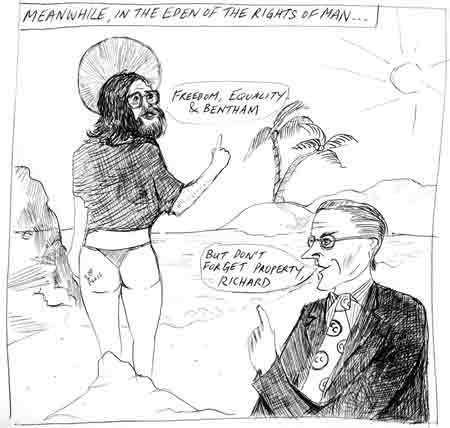 Image > Ben Seymour
To be sure, many programmers and software companies are uncomfortable with the freedoms required by the FSD. Programmers are welcome to release applications under a licence that prohibits terrorists, fascists, or pacifists from using their software but their software won’t be free. There are very good and thoughtfully considered reasons for each freedom in the FSD; there may also be very good and thoughtfully considered reasons for choosing not to use them. free software draws a line and leaves the final judgment calls up to the developers applying the licences and the users using the software.
Not every programmer has to write free software. Not every programmer does. But if coders want to call their project ‘free software’ or ‘open source,’ they must pass the bar set in the FSD and OSD. If a programmer wants their software included in Debian, listed in the free software Directory, or supported by SourceForge, free software’s core freedoms must exist for their users. As a result, few coders write ‘almost free’ software today while, proportionately, many more did two decades ago. With Creative Commons there is no bar and no essential freedom. As a social movement, CC has failed to take positions and set goals in the ways that made free software successful.
By no means is CC a bad thing – this article is distributed under a CC licence. Every CC licence clearly describes a right that cannot be taken for granted in contemporary copyright. With licences that declare an author’s intentions, the need for lawyers and permission-asking is significantly minimized. CC licences are easy to understand and easy to apply. But by failing to take any firm ethical position and draw any line in the sand, CC is a missed opportunity.
Because CC has the support of influential intellectuals, and commands high profile institutional support, the creators of CC have had an opportunity to define a movement for the production of content in what they think is a better, more ‘free’, more ‘open’, or more ‘common’ manner. They have not done so.
When asked at the World Summit on the Information Society about non-commercial use clauses, Lessig said that he thought they were overused and frequently a bad idea. For whatever reasons, three-quarters of CC-licenced works prohibit commercial use.3 Lessig provided licences and he hoped most creators’ conservatism and fears would not get the better of them. Apparently, they did; artistic works under these licences are less accessible to a large number of creators.
Perhaps a literary or musical work can be free and open and restrict commercial use. Perhaps it can’t. Inspired by the freeand open source software movement, one of the finest collections of legal and philosophical minds critical of contemporary intellectual property policy had the opportunity, foresight, and institutional and grassroots support to weigh in on a set of important issues – on either side. They did not. To this day, no widely discussed – much less widely accepted – definition of free, open, or common content exists.
This article is not an attempt to criticise the presence of non-commercial use clauses, or any of the other clauses, in Creative Commons’ licences. Instead it is a criticism of the fact that there are no defined criteria by which any clauses can be categorically blocked. It is a criticism of the fact that there is no base level of freedom that every Creative Commons licence must provide. Creative Commons’ website reads:
Too often the debate over creative control tends to the extremes. At one pole is a vision of total control – a world in which every last use of a work is regulated and in which ‘all rights reserved’ (and then some) is the norm. At the other end is a vision of anarchy – a world in which creators enjoy a wide range of freedom but are left vulnerable to exploitation. Balance, compromise, and moderation – once the driving forces of a copyright system that valued innovation and protection equally – have become endangered species.
CC’s goal of escaping a world of ‘all rights reserved’ is laudable, but they fail to describe what it will be replaced by except to say it will be better. While something slightly better is surely desirable, it might also be too little. Balance, compromise and moderation are certainly admirable and worthwhile goals; but undefined, unlimited, and unchecked, conservatism risks reducing CC’s concept of balance toward little more than ‘slightly better than the status quo.’
While CC’s licences are novel and effective tools, CC’s ‘freedom of choice’ is hardly new; it forms the foundation upon which copyright and all copyright licensing schemes work. It bears little resemblance, in scope, extent, or philosophical basis, to the Freedoms at the core of the free software movement. Lessig’s cries for ‘free culture’ are not accompanied by a description of what freedoms – of use, of distribution, or of modification – free culture will provide.
CC has replaced what could have been a call for a world where essential rights are unreservable with the relatively hollow call for ‘some rights reserved.’ If the free software example is representative of how things might have been, the total amount of freedom the consumers of creative works enjoy in the future may be the price paid for CC’s popularity.
It is not too late to discuss which rights should be unreservable in an era of free information. In fact, the rumblings of a movement to do just this have begun. Richard Stallman and others have withdrawn their support of Creative Commons and have expressed interest in supporting a ‘free culture’ movement with defined goals.
Of course, the definition of freedom remains a slippery and controversial subject. Some, like Stallman, favour a model that treats functional works as distinct from artistic or political pieces. Others have argued persuasively against the division of commercial and non-commercial works from both principled and pragmatic positions. Consensus is hardly forthcoming.
But free software was hardly built two decades ago through consensus in the software development community. The success of the free software model was built through the hard work of Stallman and the GNU project, and the free and open source software communities. The movements’ widespread popularity has been cemented through the benefits; pragmatic and principled, that only became evident with time. Whether in unison or cooperating in separate groups, it is time for those those of us that feel strongly about freedom to discuss, decide, and move forward with our own free information movement built upon a standard of freedom. When we have defined free information in terms of essential freedoms, a subset of Creative Commons works and a subset of Creative Commons licenses will provide tools and texts through which a social movement can be built.
This work is licensed under the Creative Commons ShareAlike License. To view a copy of this licence, visit http://creativecommons.org/licenses/sa/1.0/ or send a letter to Creative Commons, 559 Nathan Abbott Way, Stanford, California 94305, USA
FOOTNOTES
1 The current version of the GPL is the second version. A third version is currently being worked on by the Free Software Foundation
2 The Open Source Definition (OSD) was a verbatim copy of the Debian Free Software Guidelines (DFSG) that has diverged slightly over time – a checklist of qualities useful in determining compliance to the letter and spirit of the FSD. When the FSD is mentioned in this piece, it in almost all cases be substituted for either the OSD or the DFSG
3 Raw statistics of web links to the different licences are as good an indicator as we have of the licences’ popularity. They are available at http://lists.ibiblio.org/pipermail/cc-fr/2005-February/000295.htm and elsewhere
Benjamin Mako Hill <mako@atdot.cc> is a technology and intellectual property researcher, activist, and consultant. He is currently working as a graduate researcher at the MIT Media Laboratory in the Electronic Publishing Group

Mute Books Orders
For Mute Books distribution contact Anagram Books
contact@anagrambooks.com
For online purchases visit anagrambooks.com

Proud to be Flesh: A Mute Magazine Anthology of Cultural Politics after the Net